
How to Check Criminal History in Bastrop
Start with the kind of fact you need. A Bastrop police narrative documents the incident and officer's account. A Morehouse Parish booking entry shows custody and booking-stage charges. A Bastrop City Court or Fourth Judicial District Court file shows what reached court. Louisiana State Police holds the fingerprint-linked repository history reported from across the state. No one source answers all four questions.
- Call Bastrop Police at 318-281-1322 for its procedure to obtain a city accident report or other releasable police record.
- Describe the report by incident date, location, report number, and record type when those facts are known.
- Call Bastrop City Court at 318-283-0257 for a qualifying city, traffic, or non-hard-labor case.
- Use MPSO and LA VINE for current custody, then ask the Morehouse Clerk about a felony or district court file.
- For a complete review of one's own reported Louisiana history, follow LSP's fingerprint-based Right to Review process.
A missing name in one place is not a clean-history finding. The event may belong to another custodian, may not have reached court, or may have moved out of current custody.
Three Downtown Bastrop Record Custodians
Bastrop is the Morehouse Parish seat and has 9,691 residents in the official 2020 Census, about 37.8 percent of the parish total. That role places city and parish justice offices in a compact civic core. Their files remain distinct. Bastrop Police creates city incident and arrest reports. Bastrop City Court creates its own docket for matters within its jurisdiction. The Morehouse Parish Clerk maintains Fourth JDC files, and the district attorney decides which state charges to prosecute.
The official City of Bastrop website provides the municipal starting point.
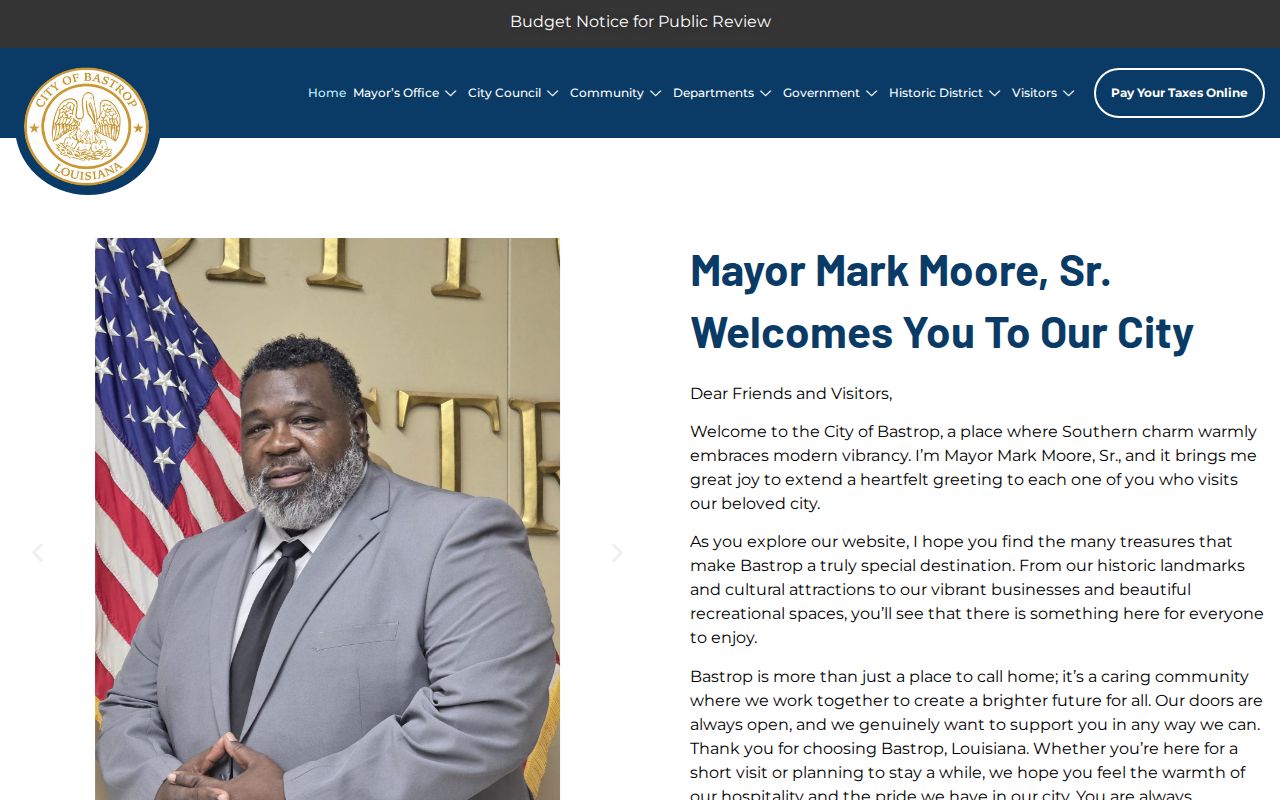
The city source anchors municipal contacts, but parish booking and district court records still require separate offices.
Bastrop Police Department Records
The Bastrop Police Department's official page tells callers seeking accident-report copies or filing complaints to use 318-281-1322. It does not publish an incident-request form, copy fee, records email, office hours, arrest blotter, or public search portal. Call first. Ask who is the records custodian, whether the requested item is releasable, what identifying details will help, and whether inspection or a copy is available.

The police page confirms the phone channel and illustrates why a routine Bastrop report request begins offline.
Preparing an incident date, location, report number, and clear record description can help staff search. Those are useful details, not claimed city prerequisites. The official page does not say that photo identification, notarization, a fixed payment method, or a set turnaround is required. If a normal phone request does not reach public material, send a narrow request under Louisiana Public Records Law.
Why Bastrop Has No Arrest Search
Bastrop Police publishes no official arrest-search controls or city blotter. That does not mean arrest records are unavailable. It means the request must follow the record. Ask BPD for a police-created report. Search the MPSO-linked LA VINE roster for present custody. Contact the right court for filed charges and final results.
Use only the official custody path. A recent Bastrop arrest may appear in LA VINE after booking, but a released or transferred person can disappear from a live roster. A spelling mismatch or feed delay can also affect results. For an older event, the police report and court docket are more useful than a current-custody list. Bastrop has no verified city jail search, and MPSO controls the parish booking and custody sites.
Arrests and Bookings in Bastrop
A Bastrop arrest can create several records at different times. The officer creates a report and probable-cause material. MPSO Corrections creates intake, fingerprints, booking data, and custody status. A judge creates initial appearance and bond orders. A court file begins when a charge or process reaches the clerk. The booking charge is the arrest-stage allegation, not the final prosecution or proof of guilt.
Check LA VINE for present custody. MPSO says its roster data updates every 30 minutes. If the search fails, call Corrections at 318-281-9336 with a name and, when lawfully available, date of birth. Note the facility and system identifier. Then request the BPD report and identify the court. A prosecutor can decline, amend, or replace an initial charge.
For a full county-focused treatment of the intake trail, use the Morehouse Parish arrest history resource. Bastrop's city-level task is to locate the BPD source and then route the booking to MPSO.
Bastrop Charges Split Between Courts
Bastrop City Court and Fourth JDC do not hold duplicate copies of every criminal matter. City Court hears legally qualifying non-hard-labor offenses, ordinance matters, traffic and DWI cases, and preliminary matters. Felony prosecutions move to Fourth JDC. The offense statute, filed charge, and procedural stage determine where a record belongs.
If the venue is unknown, ask BPD which agency received the report and ask the prosecuting office where the charge was filed. An empty Bastrop City Court result does not prove that no district case exists. Likewise, a district-court-only search can miss a city prosecution or municipal bench warrant. Search by case number when possible. A narrow name and date range can help when the number is not known.
Bastrop Municipal Court Records
Bastrop City Court is at 202 East Jefferson and can be reached at 318-283-0257. No verified public case-search form or copy-fee table was available in the official sources reviewed. Call or use the counter to ask whether a docket exists, what public entries can be inspected, and what the current copy or certification cost will be. Do not assume a case is absent because no online tool is present.
| Court name | Bastrop City Court, also described as the municipal court. |
|---|---|
| Case types heard | Qualifying non-hard-labor offenses, city ordinances, traffic and DWI matters, and preliminary proceedings. |
| Lookup channel | Call 318-283-0257 or ask at 202 E. Jefferson; no verified public search form. |
| Docket contents | Case number, filed charge, plea, hearings, minute entries, disposition, sentence, fines or costs when public. |
| Copies and fees | Ask the court for the current public copy and certification procedure; no official fee table was verified. |
A court record answers what was filed and how the tribunal acted. It does not replace the officer's narrative or MPSO booking entry.
When Bastrop Police and Court Records Differ
Different charge labels can be correct at different points. An officer records the suspected offense at arrest. The district attorney may file another charge, amend a count, or decline it. A judge can dismiss a count or enter a judgment after plea or trial. Read each source with its date and purpose.
When the records conflict, get the BPD report number, MPSO booking identifier, and court docket number. Ask the clerk for the final disposition of each charge. “Disposed” means a matter ended; it does not by itself mean convicted. A disposition may be a conviction, acquittal, dismissal, or nolle prosequi, which is a prosecutor's choice not to continue the charge at that time. For proof of the result, request a certified court copy.
Where Bastrop Criminal Records End Up
A Bastrop police event can move from city investigation to parish custody, then to a city or district tribunal. Qualifying fingerprint arrest data is reported to Louisiana State Police BCII. Courts and agencies later send dispositions to the repository. Timing gaps matter. A booking may be visible before a case exists, while a final result can take time to match to the arrest cycle.
Record flow: Bastrop Police Department › Bastrop City Court or Fourth Judicial District Court › Louisiana State Police BCII
Use BPD for the narrative, MPSO for custody, and the proper clerk for filed charges and outcome. A fingerprint-based LSP Right to Review is the subject's route to inspect statewide repository history and seek correction of missing or inaccurate entries. It is not an unrestricted public people search.
Bastrop Court Records Across Downtown
The parish courthouse dates to 1914 and is listed on the National Register of Historic Places. Official court business uses 100 East Madison, while historic and Police Jury materials use 125 East Madison. The different addresses appear to reflect entrances or offices in the same complex, so preserve the distinction when planning a record request. The Morehouse Clerk can be reached at 318-281-3343.
Bastrop also has a notable judicial link. A Louisiana Supreme Court memorial records Mack E. Barham's service as Bastrop City Court judge from 1948 through 1962 before his work on Fourth JDC and the Louisiana Supreme Court. The milestone shows that the small city tribunal is part of a longer local court history, even though its modern record channel remains separate from the parish clerk.
Reading Bastrop Criminal Record Statistics
The FBI Crime Data Explorer is the official source for current reported-crime statistics, not for individual Bastrop records. Check agency participation, reporting months, and whether the data uses NIBRS or the older Summary Reporting System. NIBRS can count all qualifying offenses in one incident, while the older method often applied a hierarchy. A blank observation is not proof of zero crime.
Historical FBI data listed a 2017 Bastrop population of 10,458, with 158 violent crimes and 986 property crimes. Those figures are not a present risk measure. The 2020 Census counted 9,691 residents, so comparing raw rates across years without the correct denominator and reporting method can mislead. Statistics describe agency reports in a period. They do not establish facts about an individual case.
Public Access Rules for Bastrop Records
Louisiana law starts with access but applies limits record by record. Police may redact or withhold active investigative material, juvenile information, medical facts, protected victim identities, and sensitive personal identifiers. Court files can also contain sealed or restricted material. Make a narrow request that identifies the record, date, agency, and desired format. Ask for an explanation when any part is withheld.
Key Statutes:
Louisiana R.S. 44:31 gives an adult a general right to inspect, copy, or reproduce public records, subject to other law.
Louisiana Code of Criminal Procedure Article 251 makes the clerk custodian and permits examination or copying during required open hours.
Louisiana R.S. 15:587 governs BCII dissemination and does not create an unrestricted public criminal-history people search.
Public access does not turn an arrest into proof of guilt. Verify the final outcome with the court that owns the file.
Choosing the Right Bastrop Record
An accident report starts with Bastrop Police. A live custody question starts with MPSO and LA VINE. A city ordinance or qualifying misdemeanor docket starts with Bastrop City Court. A felony disposition starts with the Morehouse Parish Clerk and Fourth JDC. One's statewide fingerprint history starts with Louisiana State Police.
This split is the core of Bastrop criminal history research. Each office records a different procedural moment. Check the source that answers the question, carry its identifiers to the next custodian, and confirm a final claim against the court result.